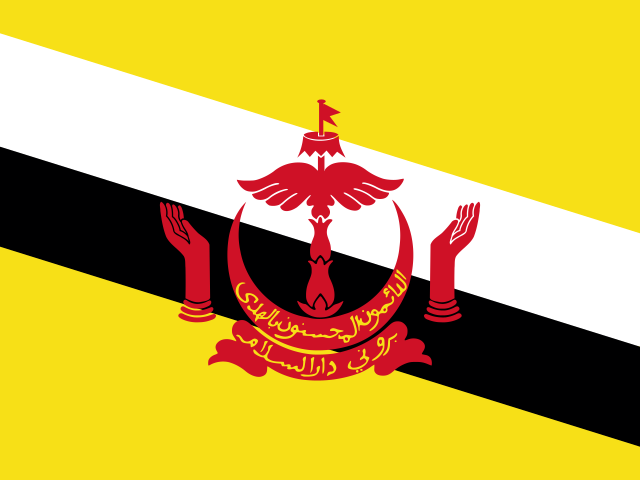
 Brunei
 visa guide
- 7 visa types
- checked 24 October 2026
How visas for Brunei work
Brunei Darussalam sorts foreign nationals into four visa categories published by the Ministry of Foreign Affairs. Category D nationals need no visa: most EU and EEA states, Switzerland, the United Kingdom, the United States and Canada get 90 days (D1); Türkiye, Japan, Korea, Malaysia, Singapore, New Zealand, Oman, the UAE and others get 30 days (D2); a further group gets 14 days (D3). Category C nationals, such as Australia, Saudi Arabia, Qatar and Bahrain, obtain a visa on arrival, while Categories A and B must apply for a visa in advance.
Visa policy is implemented by the Department of Immigration and National Registration (Jabatan Imigresen dan Pendaftaran Kebangsaan, JIPK) of the Ministry of Home Affairs. A visa waiver covers social visits only: business and professional visits need a Business Visit Visa or Professional Visit Visa, which a registered company in Brunei applies for on the visitor's behalf, and longer stays require a visa as well.
Long-term stays depend on a sponsor in Brunei. Foreign workers need an employment visa and work pass applied for by the employer through a licensed employment agent after Labour Department approval; spouses and children of work pass holders receive dependant passes; foreigners with family ties to citizens or permanent residents can hold a Long-Term Social Visit Pass. Permanent resident status is granted mainly on family or descent grounds after long periods of marriage or residence.
Which visa do I need?
Holiday or family visit: no visa for D-category nationals within their 30, 90 or 14 days; visa on arrival for C-category nationals; social visit visa from a Brunei mission for A and B nationals, and for anyone staying longer than the waiver.
Meetings, exhibitions or exploring investment: Business Visit Visa, applied for by a registered company in Brunei. Expert work on an awarded project: Professional Visit Visa. A job with a Brunei employer: employment visa and work pass. Joining a husband who works in Brunei: dependant visa and pass. Family ties to a citizen or permanent resident: Long-Term Social Visit Pass, and later permanent resident status if the category conditions are met.
Visa types for Brunei
Visits and short stays
- Tourist visa Visa waiver and Social Visit Visa
Brunei lets nationals of Category D countries visit without a visa for 90, 30 or 14 days depending on the group.
Maximum stay: Visa-free: 90 days (D1), 30 days (D2) or 14 days (D3), depending on nationality
Business and self-employment
- Business visa Business Visit Visa (BVV) and Professional Visit Visa
Brunei's Business Visit Visa covers meetings with boards of directors, expos and exhibitions, investment and exploring business opportunities; the Professional Visit Visa covers expert work on a project awarded in Brunei.
Processing time: Three working days at JIPK headquarters and the Kuala Belait branch; five at the Temburong branch
Work
- Work visa Employment Visa and Work Pass (Visa dan Pas Kerja)
Foreigners working in Brunei must hold a valid employment visa and work pass.
Family
- Family reunification visa Dependant Visa and Pass (Visa dan Pas Tanggungan)
Brunei's dependant visa is issued to the wife and children under 18 of a man working in Brunei.
- Spouse and partner visa Long-Term Social Visit Pass (Pas Lawatan Sosial Jangka Panjang)
Foreign spouses and other relatives of Brunei citizens or permanent residents who do not yet meet the conditions for permanent resident status can hold a Long-Term Social Visit Pass.
Residence
- Permanent residence Permanent Resident status (Taraf Penduduk Tetap) and Entry Permit
Permanent resident status in Brunei is granted under categories defined by JIPK, updated from 31 December 2024.
Validity: Re-entry visa and entry/resident permit issued for one year at a time for most foreign passports
Online travel permits
- Visa on arrival Visa on Arrival (Category C)
Brunei issues a visa on arrival to holders of all passport types from its Category C countries: Australia (30 days, single or multiple entry, BND 20 or BND 30), Saudi Arabia and Qatar (14 days, BND 20) and Bahrain (14 days, BND 20 or BND 30).
Maximum stay: 30 days (Australia) or 14 days (Saudi Arabia, Qatar, Bahrain)
Frequently asked questions
Do I need a visa for Brunei?
Not for a social visit if your nationality is in Category D: 90 days for most EU and EEA states, the UK, the US and Canada, 30 days for countries such as Japan, Korea and Malaysia, and 14 days for a further group. Category C nationals get a visa on arrival; Categories A and B apply in advance.
Who can get a visa on arrival in Brunei?
Nationals of Category C countries: Australia (30 days, BND 20 single or BND 30 multiple entry), Saudi Arabia and Qatar (14 days, BND 20) and Bahrain (14 days, BND 20 or BND 30). The visa form and arrival card are available on incoming flights.
Where do I apply for a Brunei visa from abroad?
At the nearest Brunei embassy or high commission. Where there is no mission, the MFA allows documents to be sent by secure courier with a prepaid return envelope; a host in Brunei can also apply to JIPK on your behalf.
Can I do business meetings in Brunei visa-free?
The MFA states that a visa application is required for business visits even for visa-waiver nationals; a registered company in Brunei applies for the Business Visit Visa on your behalf.
Is there an online arrival card?
Yes. JIPK provides an e-Arrival Card that travellers create on the Brunei INRS portal (imm.gov.bn) under "Travel Cards" and can update or cancel there.
Do I need a transit visa for Brunei?
The MFA states that Category D2 nationals do not require a transit visa. Check the MFA category page for your nationality.
Embassies and consulates
Last checked 24 October 2026. Each visa page lists the official sources it is based on.